Envision yourself walking through the orchards of Bucks County with landscape design in mind. You begin to notice more than the fruit: the tree placement, pathways, views and simple ideas that could inspire a beautiful home orchard of your own.
Bucks County orchards offer more than a place to pick peaches and plums in the summer or apples in the fall. When you look at them through landscape-design eyes, each one has something different to teach us about layout, circulation, tree selection, gathering spaces and the way an orchard fits into the larger landscape.
Commercial orchards and home orchards obviously serve very different purposes, but many of the same design principles apply: choosing the right trees, arranging them thoughtfully, creating comfortable paths and making the orchard feel like a natural extension of the property.
Solebury Orchards — Best for Simple, Beautiful Orchard Design
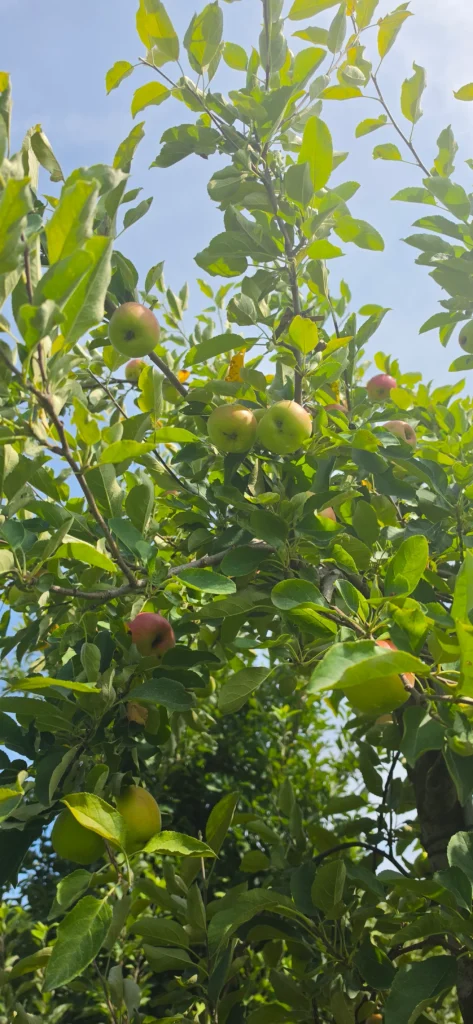
Solebury Orchards is a wonderful reminder that an orchard does not need to feel overly designed to be beautiful.
When we spoke with Nathaniel at Solebury Orchards, he told us that one of the things visitors enjoy most is simply that “it is simple.” That simplicity feels very much like part of its charm.
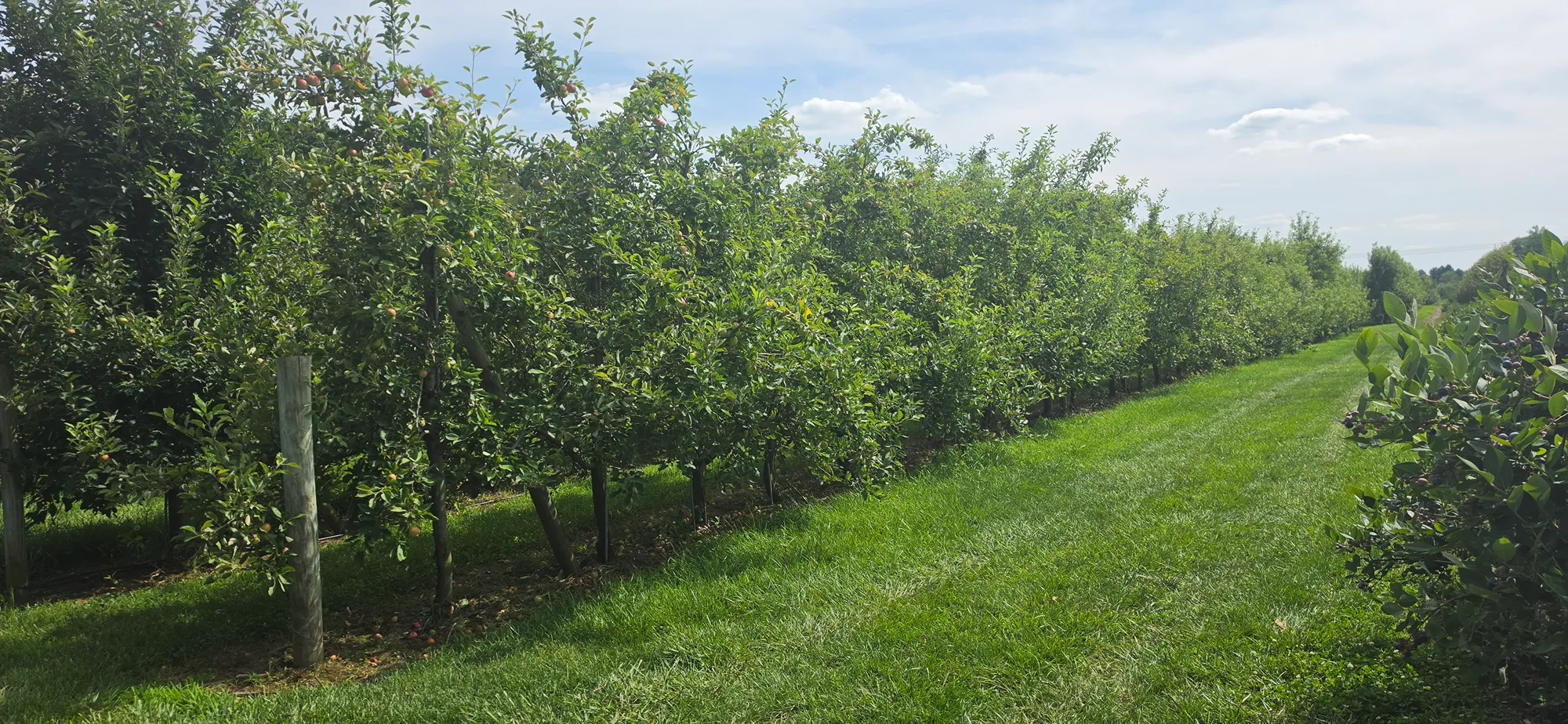
The orchard grows apples, peaches, pears, cherries, blueberries and plums, although apples are what they are best known for. Rather than competing with the landscape, the rows of fruit trees become the landscape. Repetition, open grass and the changing character of the trees through the seasons create much of the visual appeal.
That is a valuable lesson for anyone thinking about a home orchard.
You do not necessarily need elaborate hardscaping or decorative planting around every tree. Sometimes carefully placed rows of fruit trees, a generous grass path and a good view are enough.
Our conversation at Solebury also offered some practical insight that is useful when we are planning a residential orchard in Bucks County. Apples, pears and peaches can all be considered, with apple trees being an especially good choice for beginners. And a home orchard does not require acres of land—dwarf apple trees can make it possible to incorporate fruit trees beautifully into a smaller residential landscape.
Sunlight is especially important, as is pruning. Young trees also need dependable watering during establishment and protection from deer—practical considerations that need to be addressed as part of the orchard plan, not after the trees are already in the ground.
How We Would Approach a Residential Orchard
Let the fruit trees provide the structure.
When we design and install a residential orchard, we begin with the property rather than simply choosing a group of fruit trees.
We consider where the trees will receive enough sunlight, how their mature size will affect spacing, what views we want to create and how people will move through the orchard. A small row or grove of carefully selected trees can become an important landscape feature all by itself.
We might orient the orchard toward a view from the house, create a comfortable grass walk between the rows or position a bench where the trees form a natural vista.
On a smaller property, dwarf trees can give us the opportunity to create the feeling and experience of an orchard without overwhelming the landscape. On a larger property, we may use semi-dwarf trees to create longer orchard rows, generous spacing and a mix of apples, pears and peaches.
The goal is not simply to install fruit trees. It is to create an orchard that feels like an intentional part of the overall landscape.
Tabora Farm & Orchard — Best for Gathering Spaces Around the Orchard
Tabora offers a very different kind of inspiration.
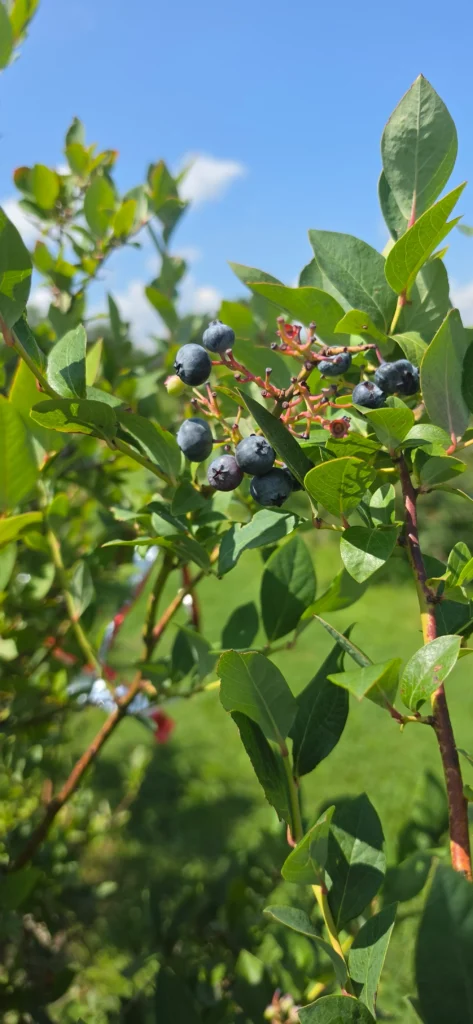
The farm store sits along the main road, with parking nearby and orchard areas arranged behind and beside it. The peach trees are planted in straight rows, with blueberry-growing areas nearby.
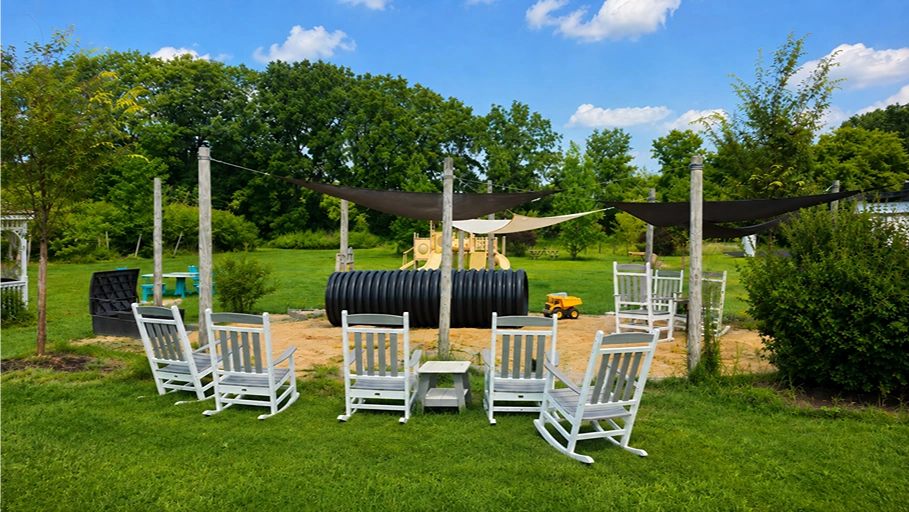
But what really stood out during our visit were the spaces created around the orchard.
There is a gazebo for shade, a large sand-play area with shade sails and seating for parents, several covered gathering areas and pergolas covered in flowering trumpet vine. Wooded views beyond the orchard create a green backdrop to much of the property.
Those details give Tabora a useful landscape-design lesson that goes beyond tree placement.
An orchard can be more than somewhere you walk through to pick fruit. It can become part of a larger outdoor experience.
How We Would Approach a Residential Orchard
Give people a reason to stay awhile.
When we design a residential orchard, we think beyond where the trees will be planted. We also consider how the family will use the space around them.
Depending on the property, we might incorporate a shaded bench at the orchard’s edge, a small pergola, a simple gathering space or a pathway connecting the orchard to a terrace, outdoor kitchen, children’s garden or other part of the landscape.
On a larger Bucks County property, an orchard can even become its own destination.
Imagine walking out after dinner to check the peaches, sitting beneath a small pergola while the children wander among the trees or carrying a basket of apples directly back to an outdoor kitchen.
Planning those relationships from the beginning allows us to install the orchard as part of the family’s outdoor living space rather than treating it as a separate planting area.
That is when a productive landscape becomes part of everyday life.
Styer Orchard — Best for the Traditional Orchard Journey
Styer Orchard in Langhorne offers another kind of inspiration: the experience of moving through a larger orchard landscape.
Styer is a preserved working orchard, and its public visitor information describes a 107-acre property with wagon rides through the orchard.
From a landscape-design standpoint, that sense of movement is interesting.
On a large property, the orchard does not necessarily need to sit immediately beside the house. Sometimes the journey toward it can be part of what makes the space special.
A path, lane or opening through existing trees can gradually reveal an orchard rather than showing everything at once.
How We Would Approach a Residential Orchard
Think about how you arrive at the orchard.
On a larger residential property, one of our first design decisions may be where the orchard belongs in relation to the house and the rest of the landscape.
Rather than simply placing rows of trees in the nearest open area, we can use the approach to the orchard as part of the design.
A mown grass path might lead from the main garden. A gravel lane could pass through existing trees before opening onto the orchard. A hedgerow might frame the entrance, or the rows themselves could be positioned to draw the eye toward a distant view.
Even a subtle change in elevation or a carefully framed sight line can make arriving at the orchard feel special.
By considering these details before installation begins, the orchard becomes part of the overall experience of moving through the property.
Good landscape design is not only about what we plant. It is also about how we want people to experience the landscape once it is built.
What These Bucks County Orchards Can Teach Us About Home-Orchard Design
One of the most interesting things about looking at orchards this way is realizing that there is no single formula for a beautiful one.
Solebury shows us the beauty of simplicity.
Tabora shows us how shade and gathering spaces can make an orchard more enjoyable.
Styer reminds us that the journey through a larger landscape can be just as important as the destination.
Those ideas can provide inspiration, but designing a residential orchard requires us to take them one step further.
Before choosing the first apple, pear or peach tree, we look at the entire property: sunlight, views, circulation, deer pressure, tree size and spacing, the architecture of the house and how the family wants to use the space.
For one homeowner, the right orchard might be six dwarf apple trees placed just beyond the kitchen garden.
For another, it might be rows of apples, pears and peaches stretching across an estate property.
The orchard could frame a view from the house, become a destination along a garden walk or include a comfortable place to sit and enjoy the trees.
Those decisions are made during the design process, before the orchard is installed, so that tree selection, spacing, paths and surrounding landscape all work together.
The important part is that the orchard feels intentional.
The trees should make sense where they are planted. The paths should invite you in. The views should make you want to walk through the space. And whether the orchard contains six trees or sixty, it should feel connected to the house and the rest of the property.
Because the best home orchard is not necessarily the biggest or most elaborate one.
It is the one that feels as though it has always belonged there. Without proper management, weakened turf becomes more vulnerable to weed invasion.